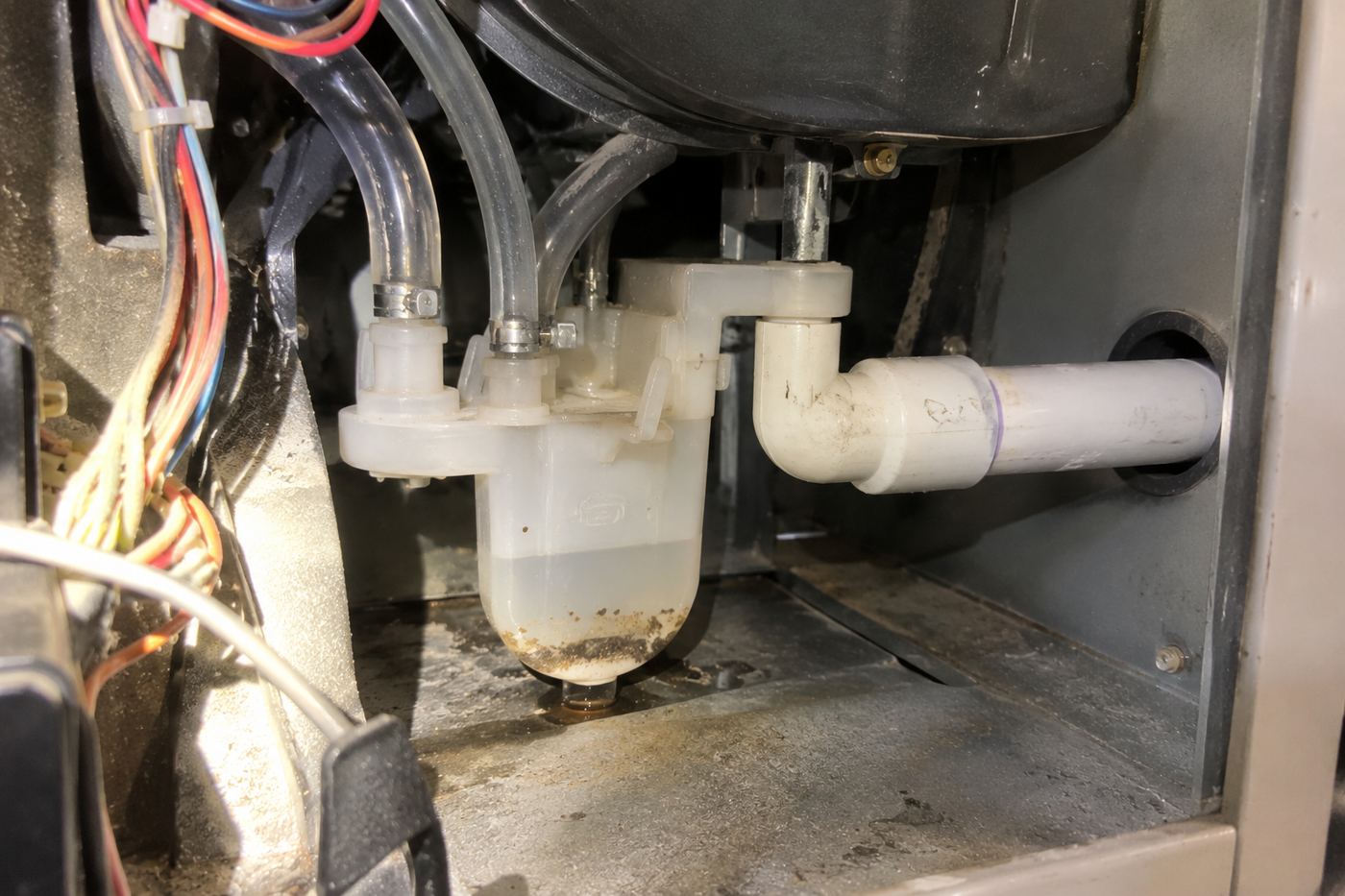
What is a furnace condensate leak?
A condensate leak is water escaping from the drain system of a high-efficiency (condensing) furnace. The water itself is normal, but it should flow out through a trap and drain line, not onto the floor.
Standard furnaces send hot exhaust up a metal flue. Condensing furnaces go a step further, using a second heat exchanger to pull more heat out of the exhaust. As the exhaust cools, the moisture in it turns to water. That is why these furnaces vent through white PVC pipe instead of metal, and why they need a drain.
The water is slightly acidic and can be steady during long runs. When any part of the path from the heat exchanger to the drain clogs, cracks or freezes, the water backs up. It may spill out of a fitting, overflow a pump, or fill the pressure switch hose until the furnace refuses to light. In Bellevue, where furnaces run through most of the fall, winter and spring, a drain problem rarely stays small for long.
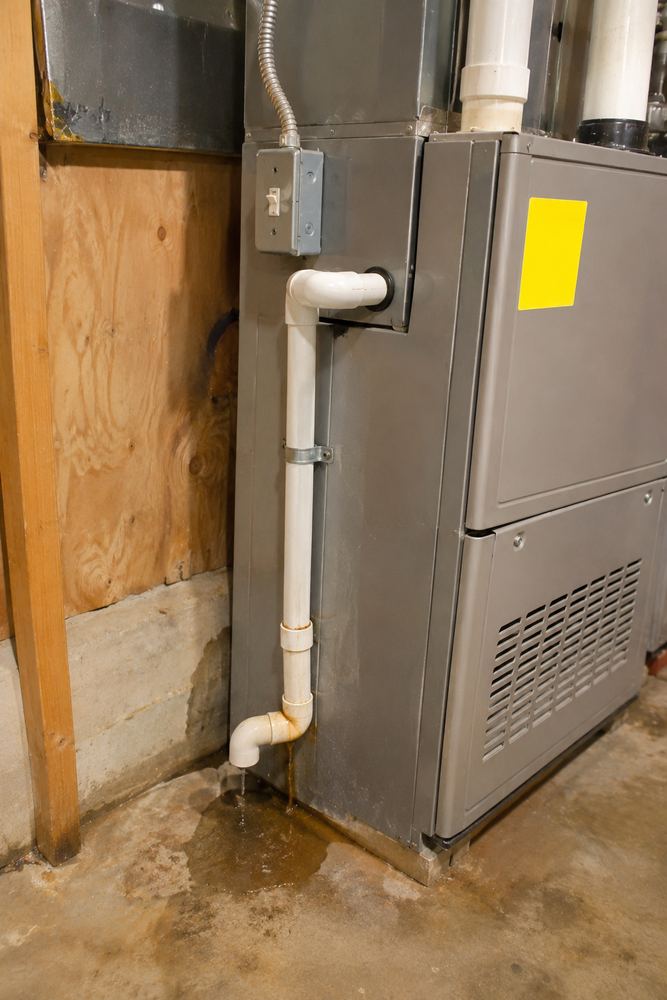
How does a technician repair a condensate leak?
The repair starts with tracing the water. A technician follows the drain path from the furnace outward: the collector box and internal hoses, the condensate trap, the drain line, any condensate pump, and finally the point where the water leaves the house. Water stains, mineral crust and wet insulation help show where the leak began.
Clogs are the most common finding. Over time, a slimy buildup forms in the trap and the low points of the drain. The tech removes and flushes the trap, clears the line, and checks that the trap is primed with water so exhaust cannot escape through it. If the trap or a hose is cracked or warped, it gets replaced rather than patched.
Condensate pumps get their own tests. The tech fills the reservoir to see whether the float lifts and the motor runs, checks the check valve and discharge tubing, and confirms the overflow safety switch is wired to stop the furnace if the pump fails. A pump that hums but does not move water, or one that runs constantly, is usually replaced.
Venting is the last part of the job. The PVC intake and exhaust need to slope the right way so condensate runs back to the furnace and not out the wall or into a low spot. In a cold snap, frost on the termination or ice in a sagging pipe can block airflow. The tech checks slope, supports, joints and the outside screens, and looks at whether any drain line passes through an unheated garage or crawl space where it could freeze again.
What are the warning signs of a condensate problem?
These signs often show up before a real puddle forms. Catching them early keeps water off the electronics.
What causes water to leak from a furnace?
The cause depends on where the water stops moving. These are the usual culprits on condensing furnaces.
- Clogged trap: slime and sediment block the trap so water spills out of the nearest joint.
- Cracked or loose drain line: vinyl tubing hardens with age and PVC joints can separate.
- Failed condensate pump: a stuck float, burned-out motor or clogged check valve.
- Frozen drain: a line running through a cold garage or crawl space freezes during a cold snap.
- Blocked intake or exhaust: frost, leaves or a nest change the draft and push water where it should not go.
- Wrong pipe slope: a sagging vent collects condensate instead of draining it back.
- Shared drain clog: a line shared with an AC coil or humidifier backs up for both.
Wooded lots like those around Bridle Trails see more needles and leaves collecting at the PVC terminations, while garage and crawl space installs in Factoria are more exposed to freezing drain lines. When a blocked drain makes the furnace light and drop out repeatedly, it can look exactly like furnace short cycling, so the drain is one of the first things to rule out.
What can you safely check first?
These checks are safe for most homeowners and can buy time until a technician arrives.
- Turn the furnace off at the switch if water is near the control board or wiring, then mop up the floor.
- Follow the drain line from the furnace to where it ends and look for a disconnected joint or kinked tube.
- Look at the pump. If the reservoir is full and the pump is plugged in but silent, it has likely failed.
- Check outside. Gently clear frost, snow or leaves from the PVC intake and exhaust without bending the pipes.
- Note the board code through the sight window before turning power off, so you can share it on the call.
Warning: Do not cut, glue or reroute the PVC vent pipes yourself. They carry exhaust out of the house, and a bad joint or wrong slope can let combustion gases or water back into the furnace.
What happens during a condensate repair visit?
A typical visit for water around the furnace runs through these steps, though each provider has its own process.
- Find the source. The tech confirms the water is condensate and not a water heater, humidifier or AC coil leak.
- Open the cabinet. They inspect the collector box, internal hoses and the pressure switch port for water.
- Clear the trap. The trap is removed, flushed, inspected for cracks and refilled so it seals properly.
- Clear and test the line. The drain is flushed through to its end point to prove water flows freely.
- Test the pump. The reservoir is filled to check the float, motor, check valve and overflow switch.
- Check the venting. Slope, supports and the outside terminations are inspected, especially after a freeze.
- Run and watch. The furnace runs a full cycle while the tech watches water move through the system and checks for drips.
If water has already soaked the control board or inducer, those parts may need testing too. Ask the provider whether anything electrical was affected before the furnace goes back into regular use.
What affects the cost of a condensate leak repair?
The price is set by the provider after they find the cause. These factors move it the most.
| Factor | Why it matters |
|---|---|
| Clog or broken part | Flushing a trap is a short job. Replacing a cracked trap, collector box or pump adds parts. |
| Pump or gravity drain | A pump adds a motor, float, tubing and safety switch to test and possibly replace. |
| Drain routing | Lines that run through a crawl space or long wall cavity take longer to trace and reroute. |
| Vent corrections | Re-sloping or re-supporting PVC venting is more work than clearing a screen. |
| Water damage to parts | A wet control board or inducer may need replacing along with the drain fix. |
When is a furnace leak an emergency?
When is it an emergency?
Call right away if water is dripping onto the control board, wiring or an outlet, if the furnace has shut down during freezing weather, or if water is spreading under flooring or into a finished room. If a carbon monoxide alarm goes off or you smell gas, leave the house and call 911 or Puget Sound Energy from outside, without switching lights.
A small, steady drip into a pan is less urgent, but it is still a sign the drain is failing. Book a visit soon rather than waiting for the first freeze.
Condensate leak questions
Why does my furnace make water at all?
A high-efficiency furnace pulls so much heat from the exhaust that the water vapor in it condenses into liquid. That water runs through a trap and drain line to a floor drain, a pump or the outside.
Can I keep using the furnace while it leaks?
A slow drip caught in a pan is less urgent than a spreading puddle. Water should never reach the control board, wiring or floor framing. If the leak is growing or near electrical parts, turn the furnace off at the switch and call.
How do I know if the condensate pump has failed?
The small reservoir will be full, the pump will not run when water rises, or it may hum without moving water. Many pumps also have a safety switch that shuts the furnace off when the reservoir overflows.
Why does my furnace stop working when it is freezing outside?
Frost or ice can build on the PVC intake or exhaust screen, or water can freeze in a drain line that runs through a cold space. Either one changes the pressure the switch reads, and the furnace shuts down to stay safe.
Is the water from my furnace or my AC?
In winter, the furnace is the likely source because the AC coil is not running. In summer, the AC coil and its drain pan are the usual suspects. Some systems share a drain line, so a clog can affect both.
Can I clean the condensate trap myself?
Some homeowners can, if the trap is easy to reach and the furnace manual shows how. Turn the power off first, and make sure every fitting is tight before turning it back on. A technician should handle cracked parts, pump wiring and venting.
Related furnace services and areas
A clogged drain is often found during routine maintenance, so a yearly furnace tune-up and safety check is a good way to catch it before the floor gets wet. To see every type of help available, visit our page on furnace repair services in Bellevue.